 English


Views: 0 Author: Site Editor Publish Time: 2026-01-09 Origin: Site


A museum is a "time capsule" of civilization, where each exhibit is a slice of history—the mottled rust of bronze ware, the flowing ink charm of calligraphy and paintings, the thread texture of brocades—all needing to "come alive" under light. In recent years, low-power small imaging lights have emerged as a new choice for museum lighting, thanks to their characteristics of "high light quality, low heat generation, and precise light control." Starting from the fundamental logic of cultural relic protection, this article analyzes how such lights achieve the ideal state of "seeing the light without feeling the heat, observing objects without damaging them."
The light damage to cultural relics is irreversible, stemming from the dual叠加 of photochemical effects (energy in light causing molecular chain breakage in materials) and thermal effects (lamp heat accelerating material aging).
Thus, museum lighting must follow four principles: "low illuminance, low color temperature, low ultraviolet, and low thermal radiation." Traditional high-power spotlights, however, often act as "invisible killers" due to their high heat output and ultraviolet leakage. In contrast, low-power small imaging lights (50-150W) can control heat below 30°C and achieve an ultraviolet filtration rate of over 99% through optical optimization, perfectly meeting the needs of cultural relic protection.

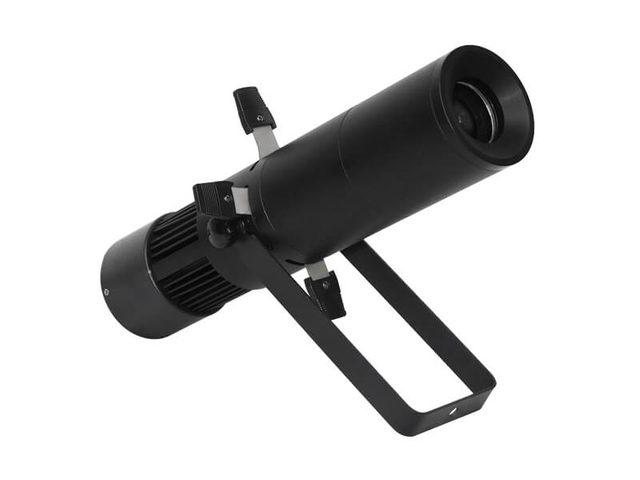
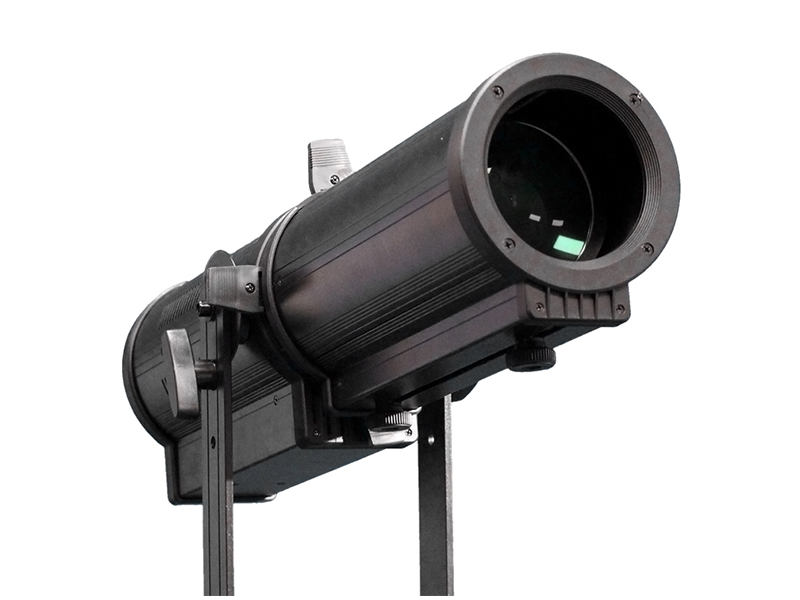
Small imaging lights are not simply "miniaturized spotlights"; they achieve a balance of "small size, big energy" through optical design innovation. Their core advantages lie in three aspects:
The essence of an imaging light is a "spotlight with a lens," which converges light into a regular spot (circular/elliptical/rectangular) with sharp, burr-free edges, precisely covering the main body of the exhibit (e.g., the core image of a painting) rather than illuminating the entire display case.
Comparison with traditional spotlights: Traditional spotlights have divergent light spots (angle >30°), easily illuminating display case glass or background boards and causing "light pollution." Imaging lights have concentrated spots (angle 5-15°), projecting over 90% of light onto the exhibit and reducing ineffective ambient lighting.
Low-power imaging lights adopt a dual technology of passive heat dissipation + high-efficiency LED chips:
LED chips: Low-power, high-efficiency chips (e.g., CREE COB chips with luminous efficacy >120 lm/W) are selected, allowing 60W power to achieve the brightness of a traditional 100W spotlight.
Heat dissipation structure: The lamp body uses aluminum alloy fins + silent fans (or fanless passive dissipation), quickly conducting heat to the exterior via the metal shell instead of accumulating at the lamp head. Test data shows: A 50W imaging light running continuously for 4 hours has a lamp head surface temperature of only 28°C; at a distance of 30cm from the exhibit, the surface temperature rise is <2°C (far below the 35°C safety threshold).
Color Rendering Index (CRI): Low-power imaging lights generally use high-CRI LEDs (CRI ≥95, some models up to 98), accurately restoring the colors of cultural relics (e.g., the blue-green of bronze ware, the five shades of ink in calligraphy).
Ultraviolet filtration: Built-in UV-cut filters (transmittance of light with wavelength <400nm <0.1%) completely block the photochemical damage of ultraviolet rays to relics.
Infrared suppression: Optical coatings reduce infrared ray (wavelength >700nm) output, lowering thermal radiation intensity.

Museum exhibits vary in materials (paper, silk, metal, ceramic, etc.), requiring adjustments to imaging light parameters (power, spot size, color temperature) based on relic characteristics.
Avoid over-pursuing "brightness": After visitors adapt to dark environments, low illuminance (30-80 lux) makes exhibits more prominent ("dark environment + bright spots" has greater visual impact than "bright environment + flat light").
Regularly check lamp status: Clean the lens every six months (dust reduces efficiency and increases hot spots) and test for ultraviolet leakage (using an ultraviolet radiometer).
Coordinate with display case glass: If using low-reflection glass (light transmittance >90%), reduce lamp power by 10%-20%; if using ordinary glass (transmittance <85%), increase power appropriately for compensation.
Reserve emergency plans: Equip important exhibits with dual-lamp backups (one working, one on standby) to avoid prolonged darkness due to single-lamp failure (sudden strong light is more likely to damage relics).

The highest realm of museum lighting is to let visitors "forget the existence of the light"—to see only the beauty of the relics, unaware of the light’s guardianship. Low-power imaging lights are such "invisible guardians": they focus on details with millimeter-level spots, convey light with low temperature and low ultraviolet, and allow millennia-old relics to face contemporary people in a safe environment. As Shan Jixiang, former director of the Palace Museum, said: "Cultural relic protection is not about locking them away, but about using scientific methods to let them ‘live’ in the present." May every beam of light in the museum become a glimmer of civilization’s continuation, illuminating the past and warming the future.