 English


Views: 0 Author: Site Editor Publish Time: 2026-08-20 Origin: Site


The absolute best effect of an LED Fresnel spotlight is its ability to cast an exceptionally uniform, soft-edged beam with precise spot light focus and controllable diffusion, eliminating multi-shadow artifacts while delivering high color rendering index metrics across professional broadcast and studio environments.
Section | Summary |
Core Beam Softness and Edge Controllability | Highlights how the primary effect of an LED Fresnel luminaire relies on stepped glass geometry to create soft, seamless blending boundaries without chromatic aberration or harsh cutoff lines. |
Optical Mechanics of Fresnel Lenses in Modern Spot Light Design | Details the structural interplay between concave reflectors, LED COB arrays, and stepped ring lenses to achieve uniform spot light projection and adjustable flood ratios. |
High Color Rendering Index and Spectrum Stability | Analyzes color fidelity, Television Lighting Consistency Index ratings, and thermal management systems that preserve color temperature integrity under continuous operation. |
Dynamic Zoom Capabilities and Beam Angle Precision | Explores mechanical drive mechanisms, precision screw shafts, and electronic zoom assemblies that adjust spot light distribution smoothly from narrow spots to wide washes. |
Energy Efficiency and Operational Thermal Control | Compares power consumption metrics, heat dissipation designs, and active cooling protocols between legacy tungsten fixtures and modern solid-state spot light engines. |
Professional Applications Across Studio and Stage Settings | Outlines real-world deployment across television broadcasting, theatrical stages, virtual production volumes, and high-end commercial spaces. |
Maintenance and Technical Considerations for Studio Engineers | Outlines best practices for optical glass cleaning, dust prevention, thermal sensor calibration, and long-term driver reliability to sustain peak fixture output. |

The premier effect produced by an LED Fresnel luminaire is an ultra-smooth, soft-edged light distribution with controllable intensity falloff.
The signature characteristic of this optical platform is its ability to produce a clean, directional wash that blends imperceptibly into adjacent lighting zones. Unlike profile fixtures that project sharp, defined edges, or broad floodlights that spill light uncontrollably across the set, a Fresnel-based spot light creates a tapered light field. This soft falloff allows lighting directors to layer multiple fixtures without creating harsh overlap lines or distracting exposure seams on camera sensors.
When lighting human subjects in broadcast studios, double shadows and harsh border reflections can ruin key lighting compositions. The ringed stepped lens breaks up parallel light rays just enough to diffuse the outer perimeter of the beam while maintaining high intensity at the center. This optical geometry ensures smooth skin tones, reduces facial harshness, and keeps background elements cleanly separated.
High-blending capability for overlapping multi-fixture setups.
Natural light attenuation from the center hot spot to the soft perimeter.
Complete mitigation of chromatic fringing along the beam boundaries.
Our continuous field feedback from broadcast studio engineers across Europe reveals that lighting operators heavily prioritize beam edge control over raw lumen output alone. European broadcast installations favor lighting configurations that feature linear dimming response curves and soft-edge output. By integrating high-density Chip-on-Board arrays behind a specialized stepped lens, our technical design eliminates the multi-shadow phenomenon commonly found in multi-chip surface-mount LED configurations, giving studio directors predictable beam mechanics.
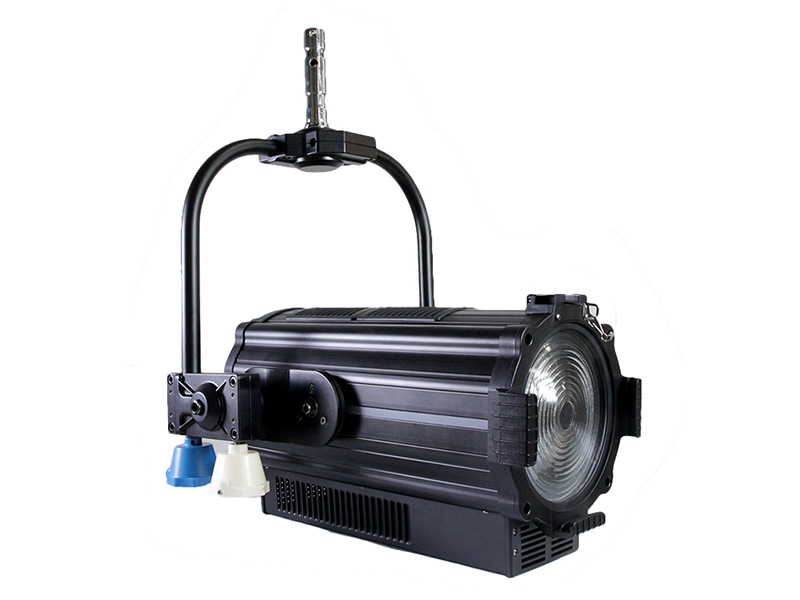
Modern Fresnel spot light fixtures combine a high-density COB LED array with precision-molded stepped glass or acrylic lenses to deliver parallel light alignment.
To understand how a Fresnel optical system functions, one must examine the physical geometry of the lens itself. Traditional plano-convex lenses require thick, heavy glass to refract light effectively, which absorbs energy and adds immense weight to overhead rigging. A Fresnel lens retains the curvature of a standard lens by collapsing the continuous surface into a series of concentric ringed steps. These steps act as individual refractive surfaces, directing light into a uniform spot light beam while dramatically reducing overall glass mass and heat retention.
In an LED-based setup, the optical engine relies on a parabolic reflector surrounding the solid-state light source to capture backward emissions. The light is driven forward through the concentric rings of the lens, organizing the light rays into a tight beam or spreading them into a broad wash depending on the relative distance between the LED engine and the lens assembly.
Optical Component | Engineering Function | Material Specification |
Concentric Stepped Lens | Focuses scattered light rays into a uniform soft-edge beam | High-purity borosilicate glass |
COB LED Engine | Provides concentrated high-lumen optical output | Flip-chip ceramic substrate |
Parabolic Reflector | Captures indirect rear light emission and directs it forward | Vacuum-aluminum coated alloy |
Mechanical Guide Shaft | Enables smooth movement of light source for beam control | Precision stainless steel |
Understanding the fundamental mechanics of how light travels through refractive elements, focal planes, and shaping accessories is crucial for maximizing studio efficiency. To explore the foundational principles of optical design and luminaire engineering in greater detail, read our comprehensive technical breakdown on how spotlights work and their optical mechanics.
Our product development team designs these optical modules with a strict emphasis on focal alignment. European broadcast clients frequently inquire why we select custom borosilicate glass over lighter acrylic alternatives. The answer lies in long-term thermal resistance: high-output COB chips generate localized thermal energy that can distort acrylic optics over thousands of operational hours, causing minor focal shifting. Borosilicate glass maintains absolute structural and optical stability regardless of run time.
Top-tier LED Fresnel luminaires offer high CRI and TLCI ratings above 95, ensuring accurate color rendering across broadcast cameras and live environments.
In professional video production, color accuracy is paramount. Low-quality LED light sources often suffer from spectral gaps, particularly in the red wavelength spectrum (R9), leading to pale skin tones, unnatural prop colors, and extensive color correction in post-production. A high-performance spot light engine utilizes specialized phosphor formulations to deliver a continuous spectral output that faithfully replicates natural daylight or tungsten illumination.
Color stability must be maintained not just at 100% output, but across the entire dimming range. Advanced pulse-width modulation (PWM) drivers and constant-current regulating circuits prevent color temperature drifting when intensity is dropped to low levels. This spectral consistency enables seamless integration alongside traditional studio light sources.
Spectral Index | Minimum Benchmark | Optical Significance |
CRI Ra | $\ge 95$ | Overall color fidelity under standard visual assessment |
CRI R9 | $\ge 90$ | Saturated red rendering critical for skin tone reproduction |
TLCI-2012 | $\ge 95$ | Camera sensor color accuracy metric for broadcast studios |
TM-30 Rf | $\ge 93$ | Fidelity index across 99 color evaluation samples |
TM-30 Rg | $98 - 102$ | Gamut index indicating balance in color saturation |
Engineers evaluating studio equipment always prioritize spectral consistency. When designing our high-output studio luminaires, we integrate custom-calibrated COB modules that undergo rigorous binning protocols. European broadcast studios frequently select our 200W LED Fresnel studio spotlight platform because it delivers absolute color rendering repeatability across multiple studio grids, preventing color shifts between different camera angles.
To maintain spectral accuracy over time, proper thermal dissipation and electronic driver calibration are necessary. For a detailed guide on how high-CRI fixtures optimize overall studio illumination and camera response, see our complete guide on spotlight optical design principles.
Integrated zoom mechanisms allow a single LED Fresnel fixture to smoothly transition from a tight spot light to a broad wash light.
The operational flexibility of a Fresnel fixture stems from its adjustable beam angle, typically ranging from a narrow $15^\circ$ beam up to a wide $60^\circ$ flood. This adjustment is achieved by changing the distance between the internal light engine and the front optical lens. Moving the light source closer to the lens spreads the light out into a wide flood, while moving it farther back creates a concentrated, high-intensity spot.
In modern broadcast and theatrical systems, this movement is controlled manually via smooth worm-gear mechanisms or motorized stepper actuators integrated into DMX protocols. Motorized control enables lighting designers to make precise focal adjustments remotely from a lighting console during live performances.
Spot Mode: Maximizes center-beam lux output for long-throw illumination and highlighting specific talent.
Medium Wash Mode: Balances coverage area and illumination level for general studio stage zones.
Flood Mode: Spreads light broadly to cover wide backdrops and multi-person sets with minimal light drop-off.
From our experience in system integration, clients frequently ask why mechanical tolerance is so critical in zoom assemblies. If the guide rails or lead screws have minor play, the light source can tilt during movement, shifting the focal center off-axis. We utilize dual steel guide rods with Teflon sleeve bearings, ensuring that the optical center remains perfectly aligned throughout thousands of zoom cycles.
To understand how variable zoom mechanics compare against fixed-beam profile projectors and beam units, consult our breakdown of spotlight mechanics and zoom systems.
LED Fresnel spotlights reduce power consumption by up to 80% compared to tungsten alternatives while producing far less operational heat.
The shift from incandescent tungsten-halogen sources to solid-state LED technology represents a major upgrade in studio energy management. A conventional 1000W tungsten Fresnel converts over 80% of its input energy into infrared heat, requiring heavy HVAC air conditioning capacity to keep studio spaces cool. A professional solid-state spot light engine converts energy into visible illumination far more efficiently, drastically lowering ambient heat loads and electrical costs.
Effective thermal management is critical for solid-state fixtures. Because LEDs emit heat from the rear substrate rather than radiating it forward through the light beam, copper heat pipes, aluminum heatsinks, and ultra-quiet cooling fans are used to maintain safe junction temperatures. Protecting the LED chip extends the operational lifespan of the fixture beyond 50,000 hours while preventing thermal color shifting.
Operational Parameter | 1000W Tungsten Fresnel | 200W LED Fresnel Equivalent |
Power Draw | 1000 Watts | 200 Watts |
Heat Output (BTU/hr) | ~3,412 BTU | ~682 BTU |
Luminous Efficacy | 15 - 20 lm/W | 80 - 110 lm/W |
Operational Lifespan | 200 - 400 Hours | 50,000+ Hours |
Dimming Energy Savings | Linear resistive loss | Pulse-Width Regulated efficiency |
During consultation with facility managers in warmer regions and throughout continental Europe, energy reduction is often listed as a primary project requirement. Replacing heavy tungsten grids with advanced fixtures like our 200W LED Fresnel studio spotlight solution allows facilities to cut energy draw by four-fifths while significantly reducing studio air conditioning costs.
For additional metrics regarding thermal dissipation, power factor ratings, and driver engineering in professional lighting systems, explore our extensive analysis of how spotlights work across modern installations.
The versatility of the LED Fresnel spotlight makes it an essential fixture in TV studios, theatres, virtual sets, and architectural lighting.
In broadcasting studios, the fixture serves as the foundation for three-point lighting setups, functioning as key lights, fill lights, and rim backlights. Its soft-edged beam allows technicians to control light boundaries using four-leaf barn doors, preventing unwanted spill onto video walls or green screen backdrops.
In theatrical spaces, Fresnels create natural overhead washes, soft pool effects, and subtle atmospheric depth. In virtual production environments using LED volumes, the precise color consistency of these fixtures ensures that physical lighting matches the digital world displayed on the video walls.
Television Broadcast Studios: Key lighting talent with high color accuracy and zero spill.
Theatrical Productions: Creating soft-edged light pools and atmosphere without harsh borders.
Virtual Production & XR Stages: Matching physical studio light to virtual environments.
Museums & Commercial Spaces: Displaying high-value items with precise beam shaping and minimal IR heat damage.
When supplying fixtures for multi-purpose event venues, customers frequently request versatility. A single platform must handle a high-consecutive-hour news broadcast in the morning and a high-contrast theatrical performance at night. Deploying versatile units like our 200W LED Fresnel studio spotlight unit gives production teams full control over color temperature, beam field softness, and barn-door edge shaping to handle shifting studio demands.
To discover how various studio production setups integrate these fixtures with soft boxes, barn doors, and control protocols, check out our guide on spotlight operational techniques and rigging setups.
Sustaining long-term optic transparency and silent operation requires structured thermal and optical maintenance.
Although solid-state fixtures require significantly less maintenance than tungsten systems—which require frequent lamp replacements—studio engineers must follow a regular maintenance routine. Dust accumulation on concentric Fresnel lens rings reduces optical output and scatters light rays, increasing beam spill. Cleaning optical lenses with isopropyl alcohol and micro-fiber clothes restores original light output.
Thermal Management Maintenance: Thermal performance directly impacts LED lifespan and color consistency. Engineers should clear dust from cooling fins and fan intakes using compressed air every six months. In whisper-quiet studio environments, monitoring fan bearing wear is essential to prevent acoustic noise from bleeding into live broadcast microphones.
Lens Care: Clean concentric rings using isopropyl alcohol every 300 operational hours.
Guide Rod Lubrication: Apply a dry silicone lubricant to lead screws to keep zoom movements smooth.
Thermal Paste Inspection: Reapply heat-sink compound every 3-5 years during overhaul servicing to ensure efficient heat transfers.
Firmware Updates: Regularly update DMX driver control software to maintain smooth dimming profiles and accurate response curves.
Engineering teams should also monitor DMX signal integrity. Long cable runs across large studio grids can introduce signal noise, causing light output to flicker. Utilizing optically isolated DMX splitters and terminating control lines with 120-ohm resistors protects delicate PWM dimming drivers from signal corruption.
To learn more about troubleshooting signal paths, optimizing driver efficiency, and managing studio power distribution, read our full article on how spotlights work and their technical operational requirements.
In conclusion, the best effect of an LED Fresnel spotlight lies in its optical versatility: delivering high color accuracy, a smooth soft-edged beam profile, dynamic zoom control, and minimal thermal output. By pairing modern COB LED engines with precision stepped lenses, these fixtures provide broadcast, theatrical, and studio spaces with complete control over lighting setups.