 English


Views: 0 Author: Site Editor Publish Time: 2026-04-10 Origin: Site


The evolution of lighting technology has seen many innovations, but few have remained as enduring and essential as the Fresnel light. Originally developed for lighthouses in the early 19th century, this unique lighting fixture has transitioned from the shores of the ocean to the sets of Hollywood and the stages of global theaters. Whether you are a cinematographer looking for that classic film noir look or a stage manager needing to highlight a specific performer, the Fresnel light is an indispensable tool in your lighting kit.
A Fresnel light is a versatile lighting instrument characterized by its unique stepped lens, which allows for a controllable beam that can be adjusted from a narrow spotlight to a wide floodlight. It provides a soft-edged beam that is perfect for blending light between multiple fixtures, making it a staple in professional video production, photography, and theatrical performances.
Understanding the mechanics and applications of a Fresnel spot is crucial for anyone involved in visual storytelling or event production. In this guide, we will delve deep into the technical specifications, the physics of the Fresnel lens, and the practical applications that make this light a preferred choice for professionals. From its ability to mimic natural sunlight to its role in modern LED configurations, we will explore every facet of this lighting powerhouse.
Section | Summary |
What is a Fresnel light? | A fundamental definition of the fixture as a wash light with a variable beam angle and a characteristic soft-edged output. |
What is a Fresnel lens? | An exploration of the thin, lightweight lens design consisting of concentric rings that focus light efficiently. |
How does a Fresnel light work? | A technical breakdown of the internal mechanism, involving the movement of the lamp and reflector relative to the lens. |
What is a Fresnel light used for? | Detailed use cases in cinema, theater, and photography, highlighting its role as a key or back light. |
Are Fresnel lights hard or soft? | A discussion on the unique quality of Fresnel light, which occupies a middle ground between harsh spots and soft banks. |
Is a Fresnel light a floodlight? | Explanation of the "flood" setting and how the light behaves when the beam is widened. |
Is a Fresnel light a spotlight? | Explanation of the "spot" setting and how the light behaves when the beam is narrowed. |
What are the different kinds of Fresnel lights? | A comparison between traditional Tungsten, Daylight (HMI), and modern LED Fresnel spot options. |
Are there any downsides to using a Fresnel light? | An honest look at limitations such as heat, weight (in older models), and light spill. |
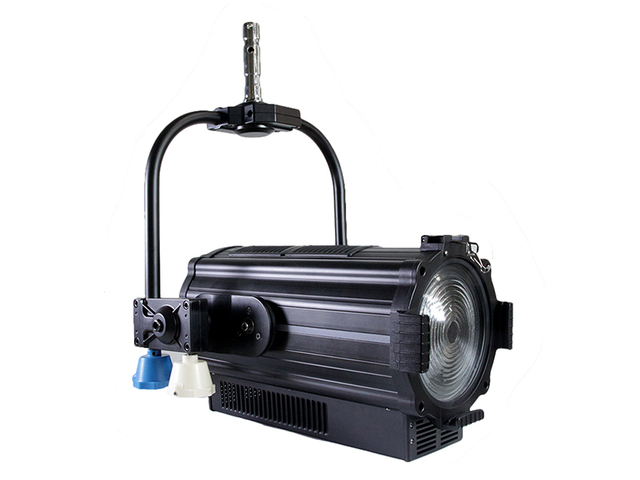
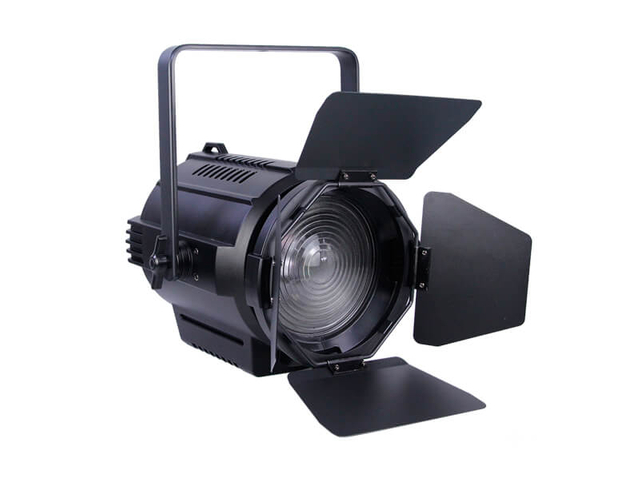
A Fresnel light is a professional lighting fixture most recognized by its "stepped" glass lens, which produces a soft-edged, controllable beam of light that can be adjusted between a spot and a flood setting.
The Fresnel spot is the workhorse of the entertainment industry. Unlike an ellipsoidal reflector spotlight which produces a sharp, defined edge, the Fresnel creates a beam that tapers off gradually. This characteristic makes it exceptionally useful for "washing" an area with light or overlapping multiple lights to create a seamless, even field of illumination across a stage or set.
Historically, these lights used tungsten-halogen lamps, which produced a warm, natural glow. However, modern iterations often utilize high-powered LED engines. These LED versions offer the same iconic light quality but with significantly less heat production and power consumption, making them ideal for modern studios where climate control and energy efficiency are priorities.
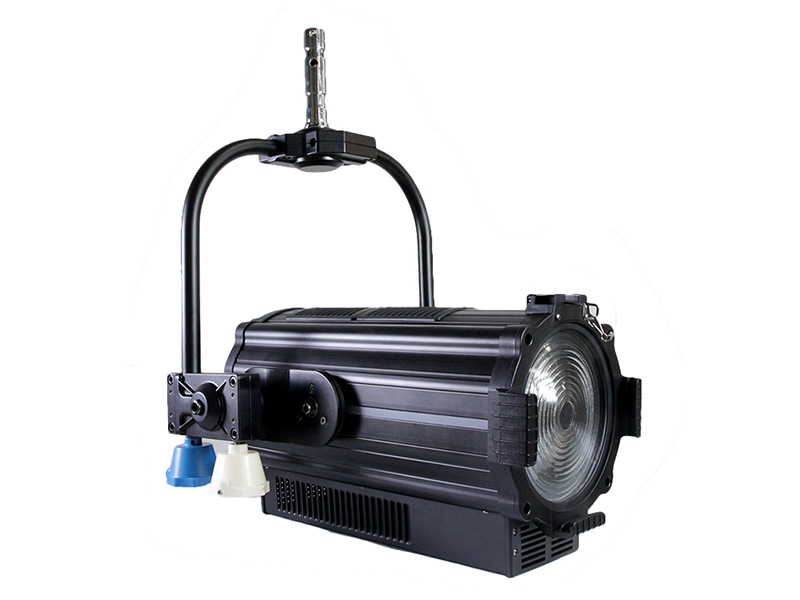
Structurally, the fixture consists of a metal housing, a lamp mounted on a movable tray, a spherical reflector, and the signature Fresnel lens. By turning a knob at the back of the unit, the user moves the lamp and reflector closer to or further from the lens, thereby changing the beam's spread. This mechanical simplicity is what has kept the Fresnel spot relevant for over a century.
A Fresnel lens is a specialized optical component that features a series of concentric grooves or rings, allowing it to focus light like a standard magnifying lens but with a fraction of the thickness and weight.
Invented by French physicist Augustin-Jean Fresnel, this lens design was a breakthrough in optics. A standard plano-convex lens of the same diameter and focal length would be incredibly thick and heavy, making it prone to cracking under the intense heat of a high-wattage lamp. The Fresnel design "collapses" the curvature of a traditional lens into a flat profile, using the rings to bend light rays toward a central axis.
This design is not just about weight reduction; it also affects the quality of the light. Each ring on the lens acts as a small refracting prism. Because the lens surface is not perfectly smooth like a traditional lens, the light is slightly scattered as it passes through. This scattering is what gives the Fresnel spot its signature soft edge, as opposed to the hard-cut shadow edges produced by other lens types.
In professional lighting, the lens is usually made of borosilicate glass to withstand extreme thermal expansion. You can identify a Fresnel lens by the "rippled" look of its surface. These ripples are precisely calculated to ensure that light is directed forward in a cohesive beam while maintaining the gentle fall-off that cinematographers and lighting designers crave for naturalistic lighting.

A Fresnel light works by utilizing a movable internal carriage that holds both the lamp and a spherical reflector, shifting them forward or backward relative to the fixed Fresnel lens to change the beam angle.
The internal physics of a Fresnel spot are remarkably efficient. The lamp sits in front of a spherical reflector which bounces light that would otherwise be lost toward the lens. When the carriage is moved toward the lens (the "flood" position), the light source becomes wider relative to the lens's focal point, causing the light rays to diverge and cover a larger area.
Conversely, when the carriage is moved away from the lens toward the back of the housing (the "spot" position), the light source aligns more closely with the lens's focal point. This causes the light rays to exit the lens in a more parallel fashion, resulting in a tighter, more intense beam. This "spot-to-flood" mechanism provides the user with an incredible range of flexibility without needing to change lenses or add accessories.
The Lamp/Light Source: Often a high-output LED or Tungsten bulb.
The Spherical Reflector: Positioned behind the lamp to capture and redirect light forward.
The Adjustment Knob: A manual or motorized control that slides the lamp/reflector assembly.
The Fresnel Lens: The final element that shapes the light into its characteristic soft-edged beam.
Because the light is focused through a single lens, the shadows produced are "clean"—meaning there is only one shadow for every object, unlike multi-source LED panels which can produce "micro-shadows." This single-source attribute is why the Fresnel spot is preferred for high-end portraiture and cinematic character lighting.
Fresnel lights are primarily used in film, television, and theater for key lighting, backlighting, and creating localized "pools" of light that look natural and blend easily with other sources.
In a typical three-point lighting setup, a Fresnel spot often serves as the "Key Light" or the "Back Light." Because the beam can be shaped and softened, it is perfect for lighting a subject's face without creating the harsh, unflattering shadows that a standard spotlight might produce. When used as a back light, it helps separate the subject from the background, adding depth to the frame.
In theatrical settings, Fresnel lights are used for "color washes." By placing a color gel in the frame at the front of the light, designers can paint the stage in various hues. Because the edges of the beam are soft, two different Fresnel lights can overlap their beams to create a smooth transition of color across the stage, which is impossible with hard-edged fixtures.
Interviews and Portraits: Providing a flattering, directional light source that mimics a window or natural light.
Product Photography: Highlighting specific details of a product with a controlled spot while maintaining soft transitions.
Theatrical General Cover: Lighting large areas of a stage evenly.
Special Effects: Mimicking sunlight coming through a window or the beam of a flashlight.
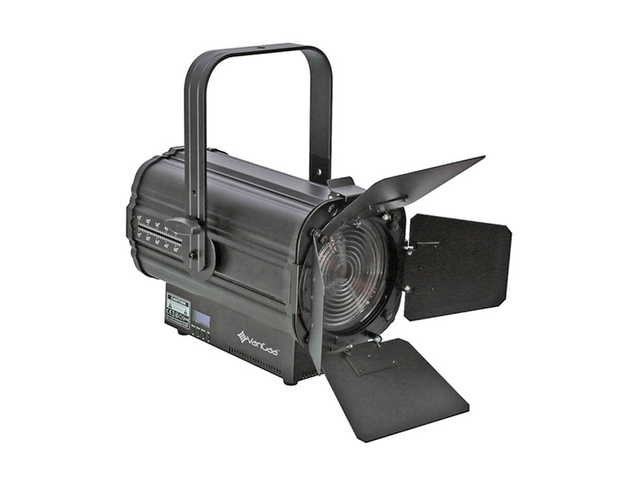
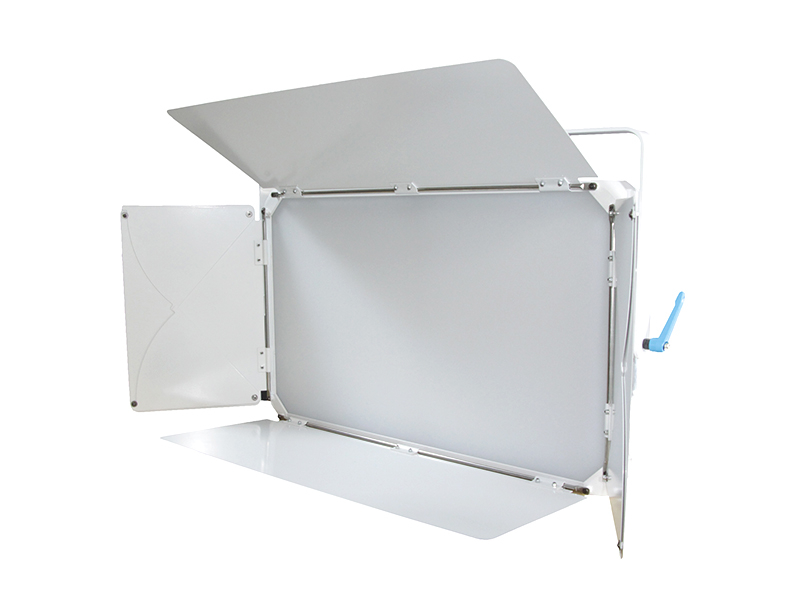
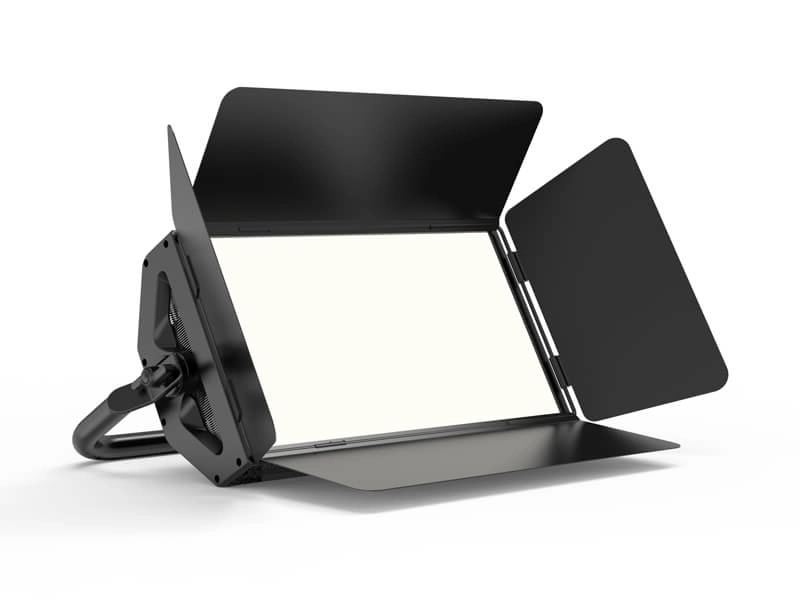
Beyond these, the Fresnel spot is often used with "Barn Doors"—four metal flaps attached to the front—to further shape the light and prevent it from "spilling" onto areas where it isn't wanted, such as a camera lens or a dark background.
Fresnel lights are technically considered "hard" light sources because they originate from a relatively small point, but they are unique because they produce a "soft-edged" shadow that is much smoother than a standard spotlight.
In the world of lighting, "hardness" refers to how quickly a shadow transitions from dark to light. A Fresnel spot produces a distinct shadow, which places it in the hard light category. However, the Fresnel lens diffuses the light slightly, meaning the edge of that shadow isn't a sharp line; it’s a gentle gradient. This makes the light more "forgiving" on human skin than an open-face light or a leko.
To make a Fresnel spot truly "soft," professionals often bounce the light off a white surface or push it through a diffusion silk. Because the Fresnel spot is so powerful and directional, it is an excellent source for "creating" soft light. By aiming a Fresnel through a large diffusion frame, you get a beautiful, soft glow that still has enough directionality to give the subject shape and dimension.
Feature | Hard Light (Open Face) | Fresnel Spot | Soft Light (Panel) |
Shadow Edge | Sharp/Harsh | Soft/Graduated | Almost Invisible |
Control | Low | High (with Barn Doors) | Difficult to Shape |
Intensity | Very High | High | Moderate |
Best For | High Contrast | Portraits/Drama | General Fill |
A Fresnel light can function as a floodlight when the internal lamp is moved closer to the lens, expanding the beam to its widest angle to cover a large area.
When a Fresnel spot is in "flood mode," it provides a wide, even wash of light. This is particularly useful for lighting backdrops, large groups of people, or filling a room with a general level of illumination. Unlike a dedicated floodlight (which often has no lens and spreads light everywhere), the Fresnel version of a flood is still somewhat "contained," meaning you still have control over where the light goes.
The advantage of using a Fresnel spot as a floodlight is the quality of the light. Even at its widest setting, the light maintains a level of punch and directionality. If you were to use a standard LED panel as a flood, the light would scatter in all directions. With a Fresnel, you can use barn doors to "cut" the light off the ceiling or floor, keeping the "flood" exactly where you need it.
This versatility is the reason many studios are stocked almost entirely with Fresnel fixtures. A single light can transition from a tight, dramatic beam to a wide, room-filling wash in a matter of seconds, reducing the amount of equipment a crew needs to carry.
A Fresnel light functions as a spotlight when the lamp is moved to the rear of the fixture, narrowing the beam to its most intense and concentrated form.
In "spot mode," the Fresnel spot delivers a powerful, narrow beam of light capable of traveling long distances. This is ideal for "throwing" light from the back of a theater to the stage or for highlighting a specific person in a crowded scene. While it is a spotlight, it does not have the "iris" or "shutter" controls found on an ellipsoidal spotlight, so the spot will always be circular and have a soft edge.
The intensity of the light increases significantly in the spot position because the light rays are being condensed into a smaller area. This makes the Fresnel spot an excellent tool for creating "God rays" or high-contrast lighting setups. For example, in a classic detective movie, the light coming through the blinds is often a Fresnel light in the spot position, placed far away to create long, dramatic shadows.
Fresnel Spot: Soft edge, variable beam, no internal shutters, great for blending.
Ellipsoidal: Hard edge, fixed or zoom lens, internal shutters to "cut" the light into squares or triangles, can use "gobos" to project patterns.
Because the Fresnel spot is more about "feel" and "texture," it is rarely used for projecting crisp patterns, but it is unrivaled for creating a naturalistic "spot" of light that looks like it belongs in the environment.
There are three primary types of Fresnel lights used in the industry today: Tungsten Fresnels, HMI (Hydrargyrum Medium-arc Iodide) Fresnels, and LED Fresnels.
Traditionally, the Tungsten Fresnel spot was the industry standard. It produces a warm light (3200K) that beautifully renders skin tones. However, Tungsten lights get extremely hot and require a lot of electricity. They are still beloved for their "dim-to-warm" capability, where the light becomes more orange as it is dimmed, mimicking the setting sun.
HMI Fresnels are "Daylight" balanced (5600K). These are incredibly powerful and are often used to compete with or mimic the sun. You will frequently see large HMI Fresnel spots on movie sets, mounted on cranes to shine "sunlight" through windows. They require a heavy external "ballast" to regulate power and are much more expensive than Tungsten or LED options.
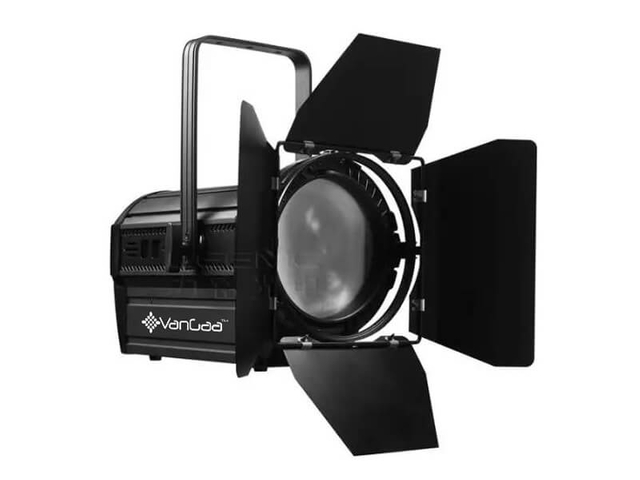
Today, the LED Fresnel spot is taking over the market. These fixtures offer several revolutionary benefits:
Low Heat: They stay cool to the touch, making them safer and more comfortable for talent.
Color Control: Many LED Fresnels are "Bi-Color" or "RGBW," allowing you to change the color of the light with a dial rather than using plastic gels.
Power Efficiency: They can often be powered by batteries, allowing for portable professional lighting in remote locations.
DMX Control: Most LED models can be controlled remotely via a lighting console, allowing for complex lighting cues in theater or live broadcasts.
While highly versatile, Fresnel lights can be heavy, and older models generate significant heat and "light spill" that requires accessories like barn doors to manage.
One of the main drawbacks, specifically of traditional Tungsten and HMI Fresnel spots, is their weight and heat. The glass lens and metal housing are heavy, requiring sturdy, expensive light stands. Furthermore, the heat they emit can make small studios uncomfortably hot and can even be a fire hazard if placed too close to flammable materials or if "gels" are used for too long without proper ventilation.
Another consideration is "light spill." Because of the way the lens refracts light, some light inevitably escapes the main beam and scatters. While the barn doors help control this, a Fresnel spot will never be as "clean" as an ellipsoidal light. If you need a perfectly sharp, localized circle of light with no light touching the surrounding area, a Fresnel might not be the right tool for the job.
Finally, there is the cost. A high-quality Fresnel spot, especially a modern LED version with high color accuracy (CRI), is a significant investment. However, for most professionals, the durability and the unique, cinematic quality of the light justify the price, as these fixtures often last for decades with proper maintenance.