 English

Views: 0 Author: Site Editor Publish Time: 2026-06-15 Origin: Site


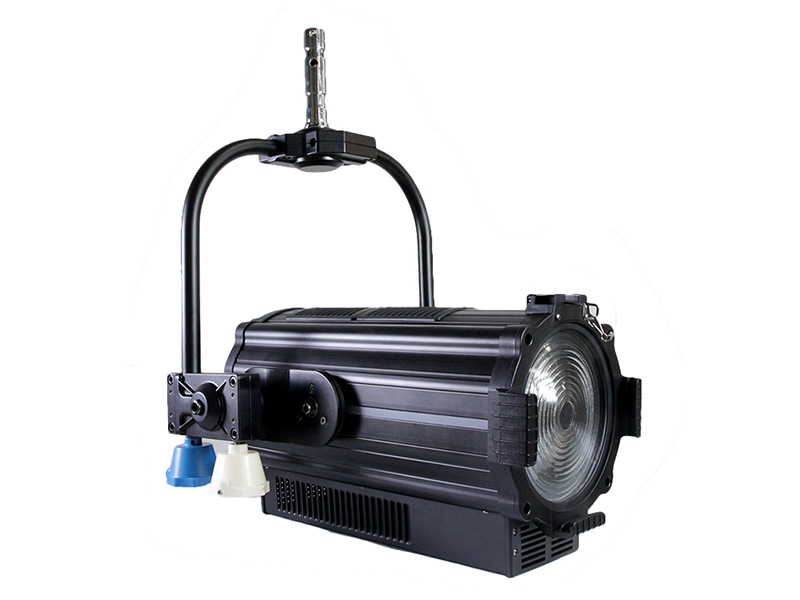
Transitioning to or upgrading LED stage lighting requires moving past basic brightness metrics. We must focus heavily on optical quality, acoustic footprint, and overall system integration. For stage productions, the wash quality and dimming curve of a fixture can easily make or break a scene. Evaluating a Led fresnel light requires strict scrutiny. You must rigorously verify its color rendering, thermal management, and DMX control capabilities. Relying solely on a spec sheet often leads to disappointing stage results.
This guide breaks down the crucial technical specifications, implementation risks, and operational criteria. We will show you how to select a professional-grade fixture specifically for theater environments. You will learn to navigate these complex choices confidently without falling for exaggerated manufacturer claims. By the end, you will know exactly how to assess these lights for your specific venue needs.
Prioritize Dimming and Color Fidelity: Smooth 0–100% dimming curves and high R9 (red) values are non-negotiable for theatrical skin tones.
Account for Acoustic Noise: Active cooling fans in high-output LEDs can disrupt quiet stage moments; verify decibel ratings under full load.
Assess Optical Flexibility: A true theater-grade fixture requires an adjustable, clean zoom mechanism and flawless barndoor shaping without color fringing.
Verify Infrastructure Compatibility: Factor in fixture weight, DMX/RDM protocol support, and power-linking capabilities for your specific rigging system.
Defining what "success" looks like must happen before reviewing spec sheets. Every venue has unique physical and operational constraints. If you skip this step, you risk buying mismatched equipment.
You must calculate the required lux at your specific trim height. Throw distance dictates how much punch you actually need. Manufacturers frequently advertise "Tungsten equivalent" wattage claims. You must critically evaluate these numbers. For example, verifying whether a 200W LED truly replaces a 1000W halogen requires reviewing photometric charts. Peak center lux does not guarantee an even field.
Use cases dictate the type of light engine you need. Differentiating between front wash and back lighting is critical. Front wash requires high CRI and variable white engines. Skin tones must look natural. Back or side lighting often prioritizes RGBW or full-color mixing arrays. Here, dramatic saturated colors matter more than perfect white light.
Follow these steps to frame your venue requirements:
Measure the exact throw distance from your rigging positions to the stage deck.
Identify the primary use case for each lighting position (front, side, or back).
Balance upfront capital expenditure against long-term maintenance needs.
Account for power savings alongside the cost of necessary accessories.
Factor in the cost of new barndoors, gel frames, and heavy-duty clamps.
Evaluating color rendering goes far beyond basic CRI. Standard CRI (Ra) is insufficient for professional stages. It averages only the first eight pastel color samples. It ignores deep red. You must check R9 values to evaluate deep reds and skin tones. When selecting a Led fresnel light for theater, a high R9 value is an absolute necessity. Furthermore, check the TLCI (Television Lighting Consistency Index). High TLCI is vital if your production includes broadcast or video elements.
Evaluating the trade-offs between variable white and multi-color engines is crucial. Variable white fixtures typically span 2700K to 6500K. They often provide better, purer output for front wash applications. Multi-color arrays offer immense flexibility. However, they risk chromatic aberration at the beam edge. You might see unnatural colored shadows.
Variable White vs. Multi-Color Arrays | ||
Feature | Variable White (Tunable) | RGBW / RGBAL (Multi-Color) |
|---|---|---|
Primary Use Case | Front wash, key lighting | Side lighting, backlighting, effects |
Output Efficiency | Higher overall brightness in white | Lower white output, high saturation |
Color Fidelity | Exceptional skin tones (High R9) | Good, but requires advanced mixing |
Shadow Quality | Clean, single-source shadow | Potential for color fringing |
Addressing a major LED implementation risk requires testing low-end dimming. The 0-10% dimming test separates professional fixtures from budget options. Low-quality LEDs exhibit "stepping" or "pop-on" at low intensities. A reliable fixture must mimic the smooth thermal decay of tungsten. It should fade to blackout seamlessly without sudden jumps.
The zoom mechanism directly impacts your production flexibility. You must choose between manual and motorized (DMX-controlled) zoom. Motorized zoom adds weight to the fixture. It also introduces a potential mechanical point-of-failure. However, it offers incredible mid-show flexibility for dynamic productions. Manual zoom remains the standard for fixed repertory plots.
Evaluating the beam angle spread is your next step. The typical range spans 15° to 60°. You must ensure the field remains flat and even. It should look clean at both the narrowest spot and the widest flood. Severe hot spots ruin theatrical wash lighting. Uneven fields make stage blending nearly impossible.
Beam Shaping Evaluation Chart | ||
Evaluation Metric | What to Look For | Common Mistake to Avoid |
|---|---|---|
Barndoor Cuts | Sharp, defined edges without multi-color shadows. | Ignoring color fringing on RGBW fixtures. |
Homogenization | Even light distribution across the entire beam field. | Accepting a bright center with dark outer edges. |
Zoom Transition | Smooth movement without light output flickering. | Using stiff manual zoom mechanisms on tall ladders. |
Testing barndoor cuts reveals the quality of the optics. LED arrays can create multi-source shadowing on barndoor edges. This causes distracting color fringing. You must evaluate the fixture’s internal homogenization lens. A high-quality lens blends the LED sources perfectly before the light exits.
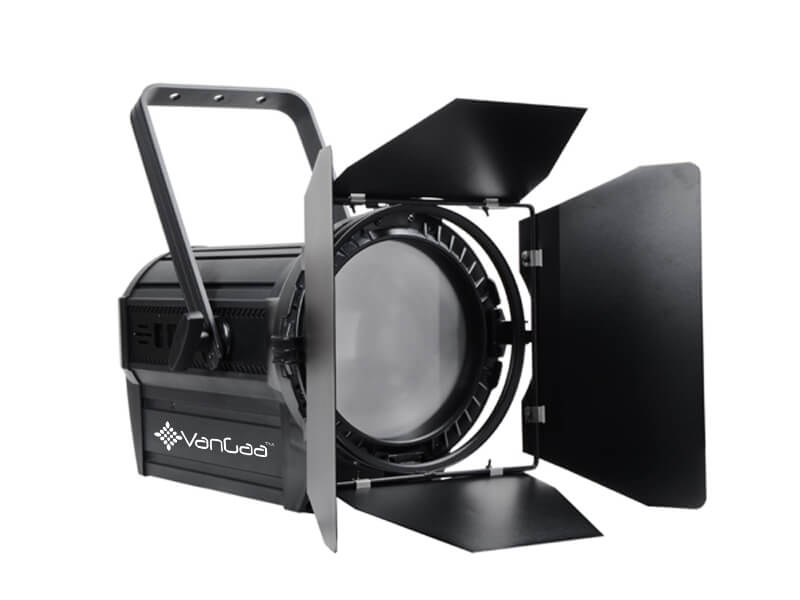
High-output LEDs generate significant internal heat. This heat requires aggressive management. You must navigate the heat/noise trade-off carefully. Passive cooling uses large heat sinks. It is entirely silent but extremely heavy. Active cooling uses internal fans. It is lighter but introduces unwanted acoustic noise. The wrong choice ruins quiet theatrical moments.
Manufacturer decibel (dB) ratings can be highly misleading. They often measure noise from unrealistic distances. You must assess fan noise in a quiet theater context.
Listen to the fixture running at 100% intensity for thirty minutes.
Check the console for a "Studio Mode" or "Silent Fan" profile.
Verify if reducing fan speed forcibly limits the light output.
Evaluate the pitch of the fan noise, not just the volume.
Understanding thermal derating is vital for live productions. Some fixtures automatically drop their brightness as they heat up. They might lose 10-20% output during a long act. This protects the LED chips but ruins your lighting cues. Always look for transparent thermal management specifications. Demand to know if the fixture sustains its peak output continuously.
Modern theatrical lighting relies heavily on advanced control protocols. Ensuring the fixture supports both DMX512 and RDM is critical. RDM stands for Remote Device Management. It allows you to address and troubleshoot fixtures remotely from the console. This saves hours of climbing ladders during focus sessions.
Dimming resolution dictates the elegance of your lighting cues. You have a strict requirement for 16-bit dimming control. It ensures perfectly smooth fades over long durations. It helps you avoid the visible, jerky steps common in cheaper 8-bit fixtures. Smooth transitions are fundamental to professional storytelling.
Assessing weight differences is a crucial physical infrastructure check. High-end LED Fresnels are often significantly heavier than tungsten counterparts. They contain robust power supplies and massive aluminum heat sinks. You must ensure your fly bars or dead-hung pipes can safely support this increased load. Calculate the total weight before purchasing.
Checking for power-linking capabilities simplifies your rig. Look for PowerCON True1 (or similar) in and out connectors. This allows you to daisy-chain fixtures together cleanly. It drastically reduces cable runs across your electrics. Less cabling means faster load-ins and cleaner stage plots.
You must insist on a physical demo in your venue. We call this the "Shootout" method. Never buy theater lighting based solely on paper specs. Specs hide flaws that only human eyes catch. What looks great on paper might look terrible on your specific stage.
Set up a side-by-side comparison matrix. Place the new LED alongside your existing traditional fixtures.
Test skin tones on actual performers or realistic wardrobe fabrics.
Run a slow, 10-second fade to blackout to test dimming resolution.
Observe the beam edge using your existing barndoors.
Listen closely to the fans while the room is completely silent.
Evaluating the manufacturer’s track record is your final step. Post-sale support matters just as much as optical quality. Check their history for timely firmware updates. Ensure parts availability, especially for replacement LED engines. Review the warranty length carefully. A robust warranty indicates manufacturer confidence in their thermal management.
Choosing the best fixture for a stage production demands careful evaluation. It is an exercise in balancing optical purity with operational realities. You must weigh color rendering against acoustic noise, weight, and control capabilities. Do not compromise on low-end dimming or R9 values. These elements are critical for theatrical success.
Your next action should be gathering hard data. Compile your venue's strict throw distances and maximum weight capacities. Determine your absolute noise limits. Use these specific constraints to narrow down your choices. Select two to three top fixtures. Bring them into your space for a rigorous, in-person shootout.
A: High-end fixtures get remarkably close using "Tungsten Emulation" modes. These modes mimic the warm red shift during dimming. They also utilize high R9 values. However, achieving a strict 1:1 identical decay requires top-tier 16-bit dimming profiles and advanced thermal management.
A: While LED chips are often rated for 50,000 hours, the reality differs. Power supplies, internal fans, or internal drivers typically fail first. Expect a realistic heavy-use lifespan of 7–10 years before the fixture requires major maintenance or component replacement.
A: It is only worth it if your production style requires frequent, mid-show beam changes. For standard repertory rep plots, manual zoom is much better. It is more cost-effective, physically lighter, and eliminates a complex mechanical failure point from your rig.